Loading project...

Loading project...
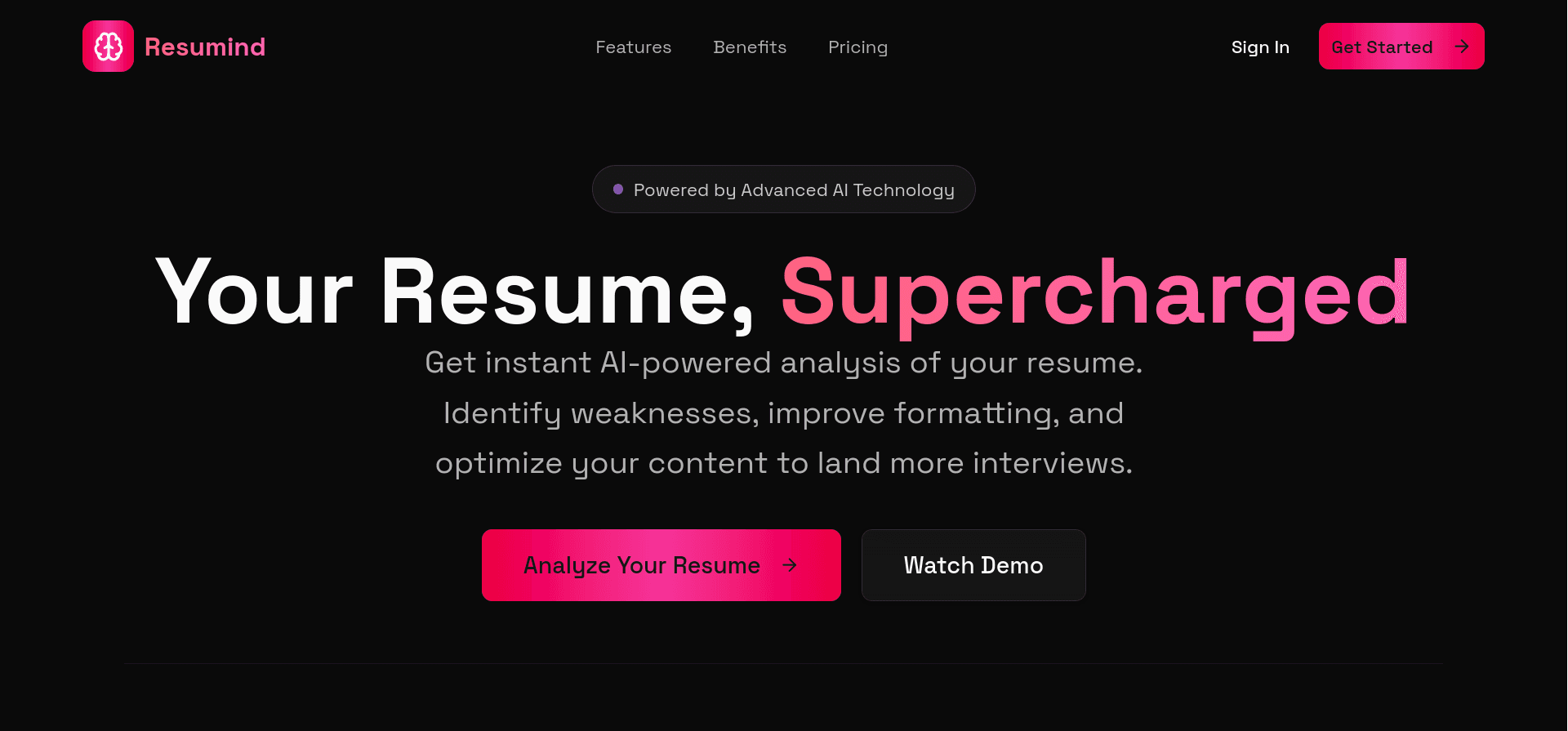
AI-powered resume analysis platform with ATS scoring and job matching
A concise look at the project, its purpose, and its value.
Resumind is an AI-powered resume analysis platform that provides instant feedback on resumes. Users upload their resume and get ATS (Applicant Tracking System) scoring, section-by-section improvement suggestions, job description matching, and personalized recommendations.
Job seekers, career changers, and professionals who want to optimize their resumes for ATS systems and improve their chances of getting interviews.
Users get actionable, AI-generated feedback in seconds instead of waiting for human review. The platform highlights exactly what's missing or weak in a resume and provides specific suggestions for improvement.
Getting quality resume feedback is expensive and slow. Human career coaches charge $100-300 per review and take days. Resumind was built to democratize access to professional-grade resume analysis using AI.
Most job applicants submit resumes that never get seen by a human because ATS systems filter them out before reaching a recruiter. Professional resume reviews are expensive, slow, and often subjective. Free tools provide generic advice that doesn't account for specific job descriptions or industries.
The impact: Qualified candidates get rejected by automated systems. Good resumes go unnoticed because they lack the right keywords. Career changers struggle to reframe their experience. The job search becomes a frustrating black box.
Resumind combines OpenAI's language models with structured analysis workflows to evaluate resumes against industry best practices and specific job descriptions. The platform parses uploaded PDFs, extracts structured resume data, and runs multiple analysis passes — ATS compatibility, section quality, keyword matching, and improvement suggestions.
What this project can do
Upload a PDF resume and get instant parsing into structured data — sections, experience, education, skills extracted automatically.
Get a numerical ATS score showing how well your resume will perform against automated screening systems.
Each resume section (summary, experience, education, skills) receives individual feedback with specific improvement suggestions.
Paste a job description and see how your resume matches against specific requirements with keyword gap analysis.
AI generates tailored suggestions for improving bullet points, quantifying achievements, and adding missing keywords.
Export the full analysis as a professional PDF report to share with mentors, career coaches, or save for reference.
View all past analyses in one place with filtering, comparison, and tracking of improvement over time.
Pay-per-analysis credit system with Stripe integration — no subscriptions, only pay for what you use.
Visual walkthrough of the project
How the system is designed and how components interact
Resumind follows a standard Next.js full-stack architecture. The frontend handles resume uploads and displays analysis results. PDF parsing happens server-side, then structured data is sent to OpenAI for analysis. Stripe handles payment processing. Analysis results and user data are stored in MongoDB.
Visual overview of system design, data flow, and key processes
End-to-end flow from resume upload through PDF parsing, AI analysis, and final report generation.
The technologies used to build this project
The hard problems that needed solving
How the system is designed for speed and scale
Prompt engineering reduces token usage by sending only structured resume data rather than raw text. This cuts both cost and response time significantly.
Indexed user ID, analysis dates, and credit ledger transactions for efficient queries. Compound indexes support the most common query patterns.
Resume parsing runs in a worker thread to avoid blocking the main Node.js event loop. Large PDFs are processed in chunks with progress tracking.
How the system is protected
Stateless JWT authentication with email verification required before first analysis. Tokens have configurable expiration and refresh mechanism.
All user inputs validated on both client and server side. File uploads checked for type, size, and content signature to prevent malicious uploads.
Uploaded resumes are stored with random filenames, never user-supplied names. Files are deleted after analysis. PDF generation runs in a sandboxed environment.
All API keys, Stripe secrets, and database credentials managed through environment variables with no hardcoded secrets.
API routes protected by rate limiting to prevent abuse. Analysis endpoint limited per user per time window.
What I learned building this project and what I'd do differently
A single parsing strategy will fail on edge cases. Building a fallback chain with progressively more aggressive parsing techniques ensures reliable results across diverse document formats.
Deducting credits requires careful handling of concurrent requests. MongoDB's atomic operations ($inc with validation) prevented race conditions where users could consume more credits than they had.
Early on, duplicate Stripe webhook events caused double credit top-ups. Implementing idempotency key tracking in the database resolved this completely.
I'd add batch resume analysis for career coaches, integration with LinkedIn profiles for comparison, and a resume builder that incorporates AI suggestions directly into an editable template.
Other projects you might find interesting
I build AI-powered document analysis systems. Let's discuss how I can help with your project.