Loading project...

Loading project...
Production enterprise system serving 200+ students and 40 teachers at a real educational institute
A concise look at the project, its purpose, and its value.
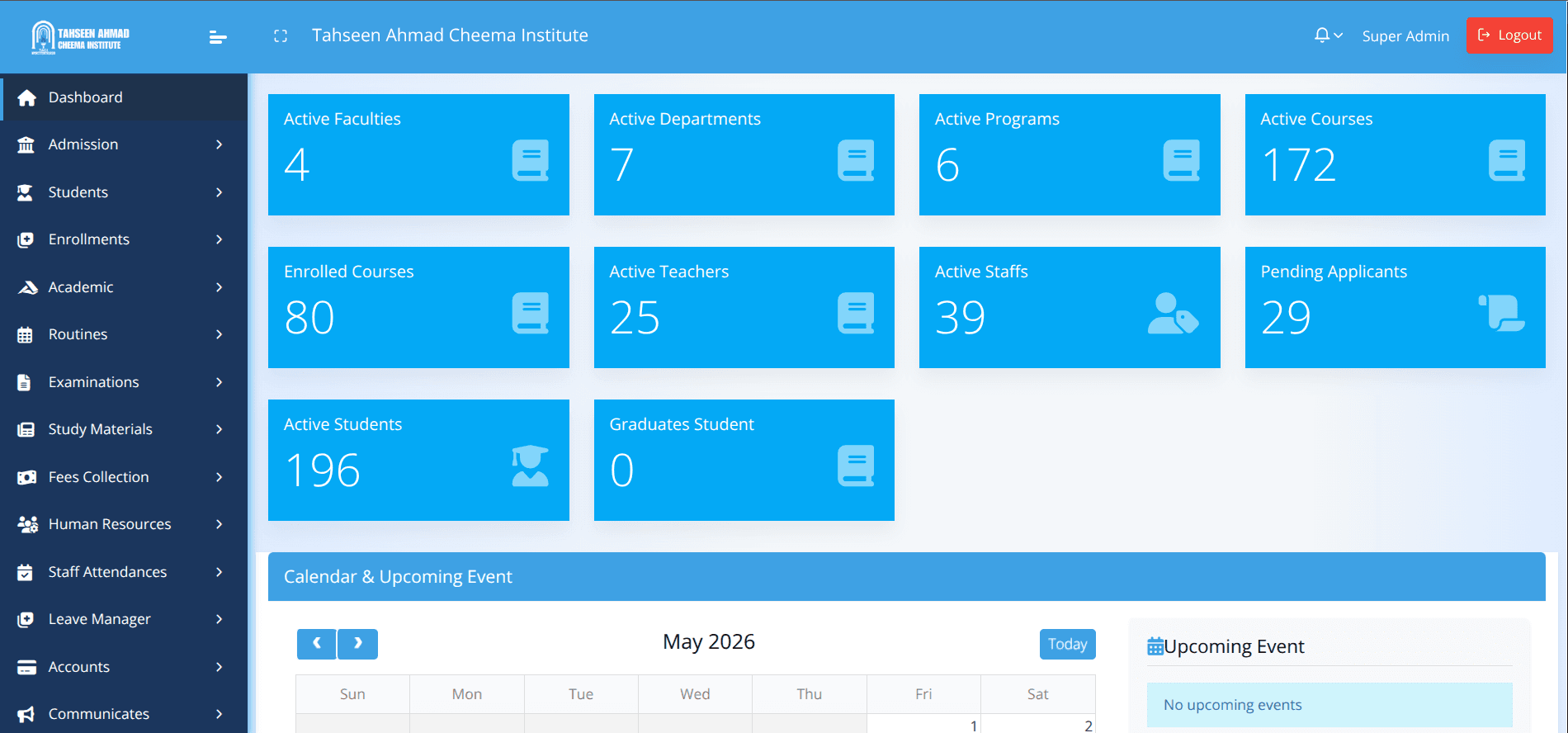
TACI is a comprehensive institution management system deployed at a real educational institute. It handles admissions, attendance, finance (dual-entry accounting with standard reports), examinations, fees, salaries, and role-based access control for administrators, teachers, and staff.
Educational institutions that need to digitize and streamline their operations — student records, financial management, attendance tracking, and examination processing.
The institute migrated from manual paper-based processes to a unified digital system. Student admissions, fee collection, salary processing, attendance tracking, and examination management all run through a single platform with role-based access.
The institute was running entirely on paper and spreadsheets. Student records were hard to find, financial reconciliation took days, and reporting required manual data aggregation. They needed a production system, not a prototype.
The institute managed admissions, attendance, fees, salaries, and examinations through paper records and spreadsheets. Finding a student's complete history required digging through physical files. Financial reconciliation was a multi-day manual process. Generating reports for management required hours of data aggregation.
The impact: Administrative staff spent more time on data entry than on actual administration. Financial discrepancies were common and hard to trace. Parent inquiries about fee status or attendance required manual file lookup. Growth was limited because scaling paper processes wasn't feasible.
TACI replaces paper and spreadsheet processes with a centralized web platform. Built with Laravel and MySQL for reliability and data integrity. Dual-entry accounting ensures financial accuracy with standard report generation (balance sheet, income statement, trial balance, ledger, cash flow). Role-based access ensures teachers, accountants, and administrators each see only what they need.
What this project can do
Complete student lifecycle from admission to graduation. Digital records, document storage, and academic history tracking.
Full double-entry bookkeeping with automated journal entries, ledger management, and 5 standard financial reports.
Daily attendance recording with automated reports. Absence notifications and monthly attendance summaries.
Exam scheduling, grade entry, mark sheets, and result processing with automated report cards.
Fee structure configuration, collection tracking, due date reminders, and overdue reports.
Staff salary management with automated calculations, deduction handling, and payment tracking.
Real-time dashboard with key metrics — enrollment numbers, fee collection status, attendance rates, and financial summaries.
Granular permissions for Admin, Teacher, Accountant, and Staff roles. Each role sees only relevant modules and data.
Visual walkthrough of the project
How the system is designed and how components interact
TACI uses the Laravel MVC framework with MySQL database. The application follows a traditional server-rendered architecture with Blade templates. Authentication uses Laravel's built-in session-based auth. Role-based middleware protects routes. Financial data uses double-entry accounting principles with transaction logs for complete audit trails.
Visual overview of system design, data flow, and key processes
End-to-end flow of invoice generation, approval chain, payment processing, and reconciliation in the accounting system.
The technologies used to build this project
The hard problems that needed solving
How the system is designed for speed and scale
All database queries use proper indexing on foreign keys and frequently queried columns. Complex reports use optimized SQL with aggregations running at the database level.
Frequently accessed data (student lists, class schedules) is cached with configurable TTL. Dashboard metrics are cached and recalculated on data changes rather than on every page load.
Blade templates render server-side, providing fast initial page loads. No client-side rendering overhead for the core functionality.
How the system is protected
CSRF protection on all forms, XSS prevention through Blade escaping, SQL injection prevention via Eloquent ORM query parameterization.
Granular permissions per user role. Middleware on every route. UI elements conditionally rendered based on user permissions.
Server-side validation on all form inputs. File uploads restricted by type and size. Data sanitization before database storage.
Laravel session-based authentication with configurable session lifetime. Sessions invalidated on logout. HTTPS enforced in production.
Financial transactions include complete audit trails with timestamps and user attribution. All financial reports include reconciliation checks.
What I learned building this project and what I'd do differently
Building for a real institute revealed countless edge cases that would never occur in a demo project. Fee discounts, partial payments, split attendance sessions, exam scheduling conflicts — real users find every gap in your design assumptions.
Implementing double-entry accounting taught me that some domains require actual domain knowledge, not just coding ability. I had to learn accounting principles before I could write accounting software.
The best software fails if users don't know how to use it. Investing in training sessions, documentation, and a simple onboarding flow was essential for adoption.
I'd add a parent portal for fee payments and attendance tracking, automated SMS/email notifications, and integration with national examination boards for electronic result submission.
Other projects you might find interesting
I build production systems for real organizations. Let's discuss how I can digitize your operations.